Source: Das Nordlicht, 29 December 1921 · 📰
From: Balmas, Bessarabia
25 November 1921
Dear Nordlicht:
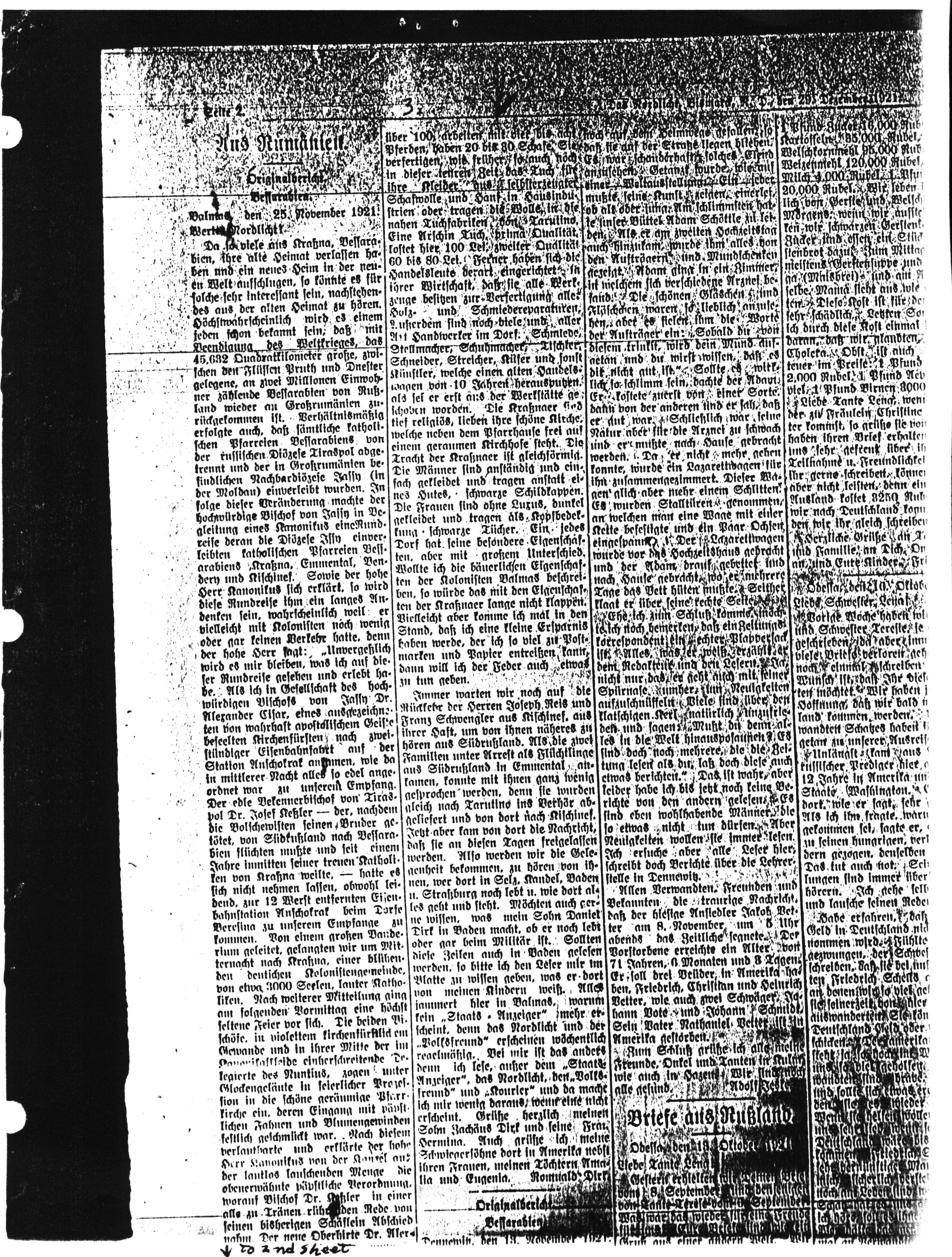
Since so many folks left Krasna for the New World, it may be of interest to them to hear some news from the old homeland. I am sure that you all know that Bessarabia reverted back to Greater Rumania after the World War. The region consists of 45,632 square kilometers, is bordered by the great rivers Pruth and Dnjestr and has a total of two million inhabitants.
In accordance with the circumstances the catholic communities were cut off from the former diocese of Tiraspol and annexed to Jassy, Moldavia. The revered Eminence, Bishop of Jassy then toured his new Catholic communities of Bessarabia, Krasna, Emmental, Bendery and Kischinev. The Eminence vocalized that he would never forget this unique experience, which would become an everlasting memory to him. He probably had never seen Bessarabian colonists before.
When I arrived in Anschorak [Tarutino] in the middle of the night in the company of His Eminence, Bishop of Jassy, Dr. Alexander Cisar, after a two-hour train ride, we were welcomed with great fanfare. The bishop is an excellent Lord of the church and totally inspired by the spirit of the apostles. The noble bishop of Tiraspol, Dr. Josef Kessler, who had to flee from the Bolsheviks after his brother was murdered in South Russia, and who spent some time in Bessarabia with his faithful flock of Krasna, insisted on traveling the 12 Werst distance to Anschorak [Tarutino] near the village of Beresina and welcome us there in person.
Accompanied by a large crowd of people, we arrived in Krasna a little after midnight. Krasna is a blossoming German colony of about 3,000 people, all Catholics. After a brief announcement, the villagers were treated to a rare occurrence on the following day. Both bishops, festively adorned in their purple garb of princes of the church, arrived at the village church with ringing church bells. The delegate Papal Nuntius preceded them in cardinal colors as they entered the church, decorated in papal colors, flags and flowers.
After the High Mass, the Eminence announced the Papal decree of annexation to Jassy and Bishop Kessler bade farewell to his former flock. No eye remained dry in the large crowd. The new chief shepherd, Dr. Alexander Cisar then greeted his new flock and assured them of his fatherly love. Then he gave his bishoply benediction and ended the high celebration.
A signing of the protocol followed in the parish office. This was witnessed by both bishops, village pastor Bernhard Leibham, representatives of the church council; namely, Peter and Gottlieb Leintz, Maximilian Hein, M. Volk, S. Dirk, A. Sauterle and M. Ternes.
After the formalities had been observed, the high guests were eager to mingle with the villagers of Krasna. He was offered the home of the district judge to hold an informal gathering to exchange thoughts over a glass of native wine. It was a pleasant evening.
He talked of the people of Banat and voiced the hope that the Suebian Agricultural Association would send representatives. He also received his share of information about land and people, as is usual in farming communities, specifically in Krasna. Agriculture, vineyards, horses, cattle and sheep were popular topics as well as commerce.
Krasna people visit all the larger marketplaces accessible to them. These would be from the Black Sea to the borders of the land where they exchange wares, barter and sell. The Krasna farmers have money. They are the wealthiest farmers of the Akkermann District and own land ranging from 6 Hectares to 60 Desjatines of land. Some own well over a hundred Desjatines. They work with 4 to 8 draft horses, own between 20 and 30 sheep, and still manufacture cloth for clothing, homespun wool and hemp, or they take their wool to the nearby cloth factories of Tarutino. Prime quality cloth fetches 100 Lei per Arschin, secondary quality between 60 and 80 Lei. Merchants are equipped to handle anything from woodworking to ironsmith repairs. There are a variety of artisans and craftsmen in the village. Smiths and wheelwrights, shoemakers, carpenters, painters, coopers and others who can make a rundown merchant’s cart, used for a decade, look like it just came off the factory line.
Krasna folk are deeply religious and love their old church, which is located next to the parish by the large cemetery. The people dress uniformly, black ball type caps instead of hats. Simple, decent clothing for the men and their wives are dressed simply without luxury. Their head covers consist of large shawls usually black in color. Each village has its individual dress costumes, which are very distinctive and characteristic of their village origin. The differences between the Krasna culture and the Balmas culture are vast. Should a kind soul send me enough paper and ink, as well as money for postage, I am willing to put it in writing.
We are still waiting for the return of Mr. Joseph Reis and Franz Schwengler who are still imprisoned in Kischinev. We are all eager to learn what is going on in South Russia. When the refugee families came to Emmental under guard, before being transported to Tarutino, then to Kischinev, not many words could be exchanged with them. Rumor has it, that the prisoners are about to be set free. So we should be hearing firsthand what is happening in Selz, Kandel, Strassburg and Baden.
I would like to know what happened to my son, Daniel Dirk in Baden, whether he is alive or, horrors, has been drafted into the military. If there are any readers out there in Baden who know of my children, please let me know via this publication.
All of Balmas is lamenting that we are no longer getting the Staats-Anzeiger as our Volksfreund and Nordlicht papers come regularly as well as the Kourier. I myself don’t mind terribly if that paper is missing. I enjoy the ones I am getting.
Greetings to my son Zachaeus [Zachäus] Dirk and wife Hermina as well as my sons-in-law in America and their wives, and my daughters Amalia and Eugenia.
Romuald Dirk