_English_
Sidebar

en:dokumente:zeitungen:eureka:i-19170508-q1-paper
Source: Eureka Rundschau, 8 May 1917 · 📰
Eureka, South Dakota
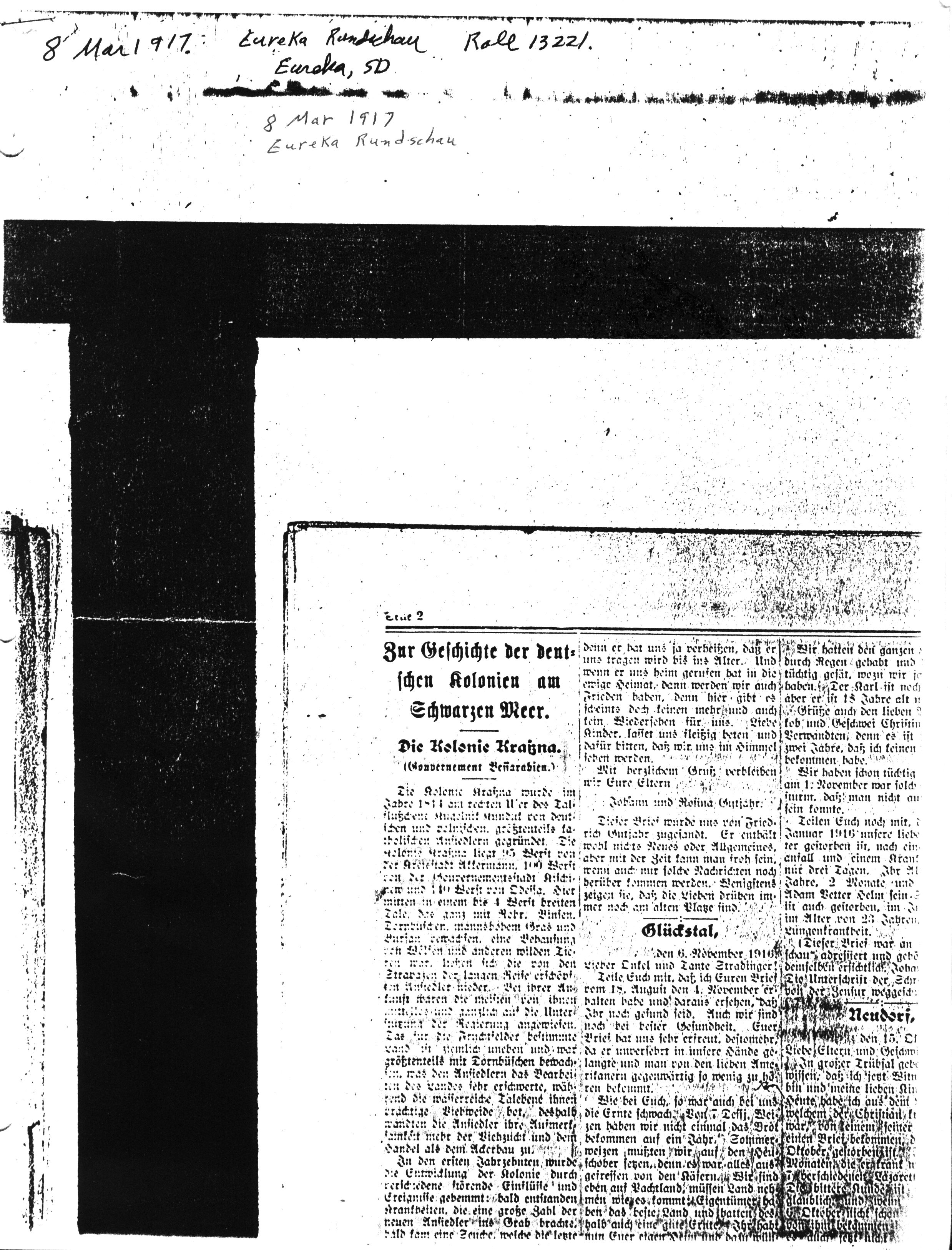
CONTRIBUTION TO THE HISTORY OF A GERMAN COLONY ON THE BLACK SEA The Colony of Krasna (Gouvernement Bessarabia)
Mostly German and Polish settlers of the Catholic faith founded the colony of Krasna in 1814 on the right shore of the Kogelnik River. Krasna is 95 Werst distant from the district capital of Akkermann, 100 Werst distant from the Gouvernement town of Kischinev and 149 Werst distant from Odessa. The valley there is 4 Werst wide and at the time of Krasna's origin, it was a wilderness of reeds, tall grasses and thorny brush, and home to wild creatures such as wolves. Here the settlers, exhausted from the taxing journey, decided to settle. At their arrival, most of them were at the mercy of the government in terms of supplies to convert the wilderness into the grain basket it was destined to become. The region was not entirely flat and was overgrown with thorny brush. This made clearing of the land difficult, but the water-rich bottom of the valley provided excellent grazing for livestock. The first settlers paid more attention to raising livestock and commerce than farming.
The first decades since its founding, disturbing influences and events hindered the development of the colony. Strange diseases claimed a share of the settlers; an epidemic among the livestock took the last cow or the last team of oxen. The few agricultural products they produced were seldom sold at value as the product was produced too far distant from the markets demanding them. The lack of cash led to a vivid bartering system. To haul a load of grain 140 Werst into Odessa was a weeklong affair and fraught with danger, as there were bandits and gypsies in abundance.
A portion of the villagers was Catholic, the other Lutheran. They could not coexist together peacefully for a long period of time. The arguments, bickering and politicking only ceased when the Lutherans decided to found a separate village, Katzbach, 8 Werst distant, on land set aside for that purpose on the western shore. From then on, Krasna had an almost solid population of Catholics who lived together in peace and unity.
Krasna completed its first church in 1865, followed by a school with an apartment for the teacher on the left-hand side of the church and the rectory with its vegetable garden and fruit orchard to the right. Both these buildings were finished in 1885. The original schoolhouse is much too small for the current number of students. It measures 10 Faden in length and 3.5 Faden in width, yet should accommodate 200 students. This situation will soon be rectified.
The colony consists of 6,910 community desjatines, has 114 farmsteads and about 54 landless families, not counting people living outside the village limits. Krasna has not purchased much land as of yet, as the families leaving the village immigrated mostly to foreign countries. For instance, the Romanian village of Karamurat was predominantly built by Krasna emigrants. Lately, most immigrants went to North Dakota and Canada, as well as the Caucasus regions.
Krasna has 1,864 inhabitants, all of Catholic faith, a church, a school with 2 teachers and 225 students, 14 blacksmiths, 8 coopers, 3 carpenters, 2 tailors, 8 shoemakers, 2 painters, 3 general stores, 3 wine merchants, l windmill and l steam mill.
en/dokumente/zeitungen/eureka/i-19170508-q1-paper.txt · Last modified: by 127.0.0.1


