_English_
Sidebar

en:dokumente:zeitungen:eureka:w-19300404-q1-paper
Source: Dakota Rundschau, 4 April 1930 · 📰
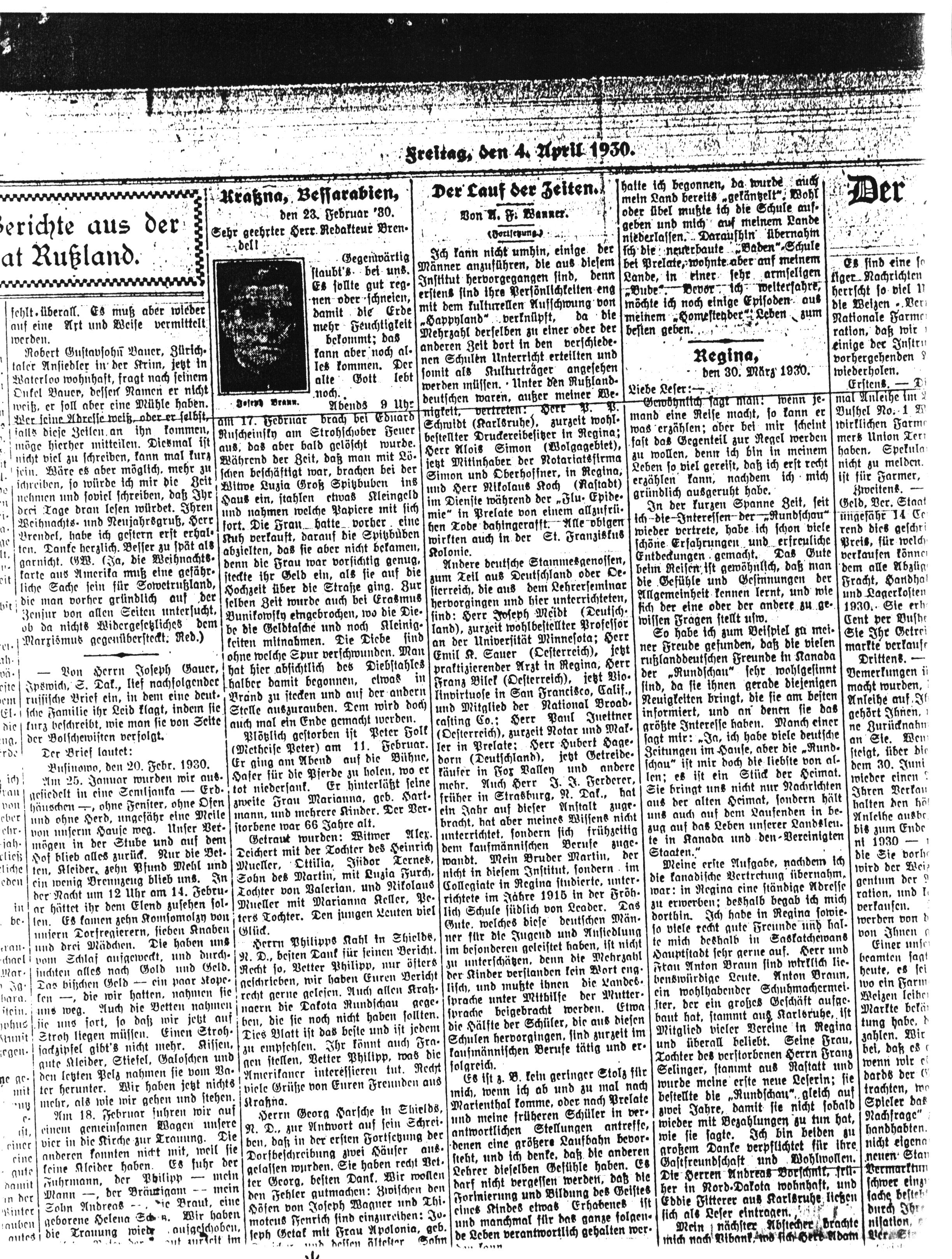
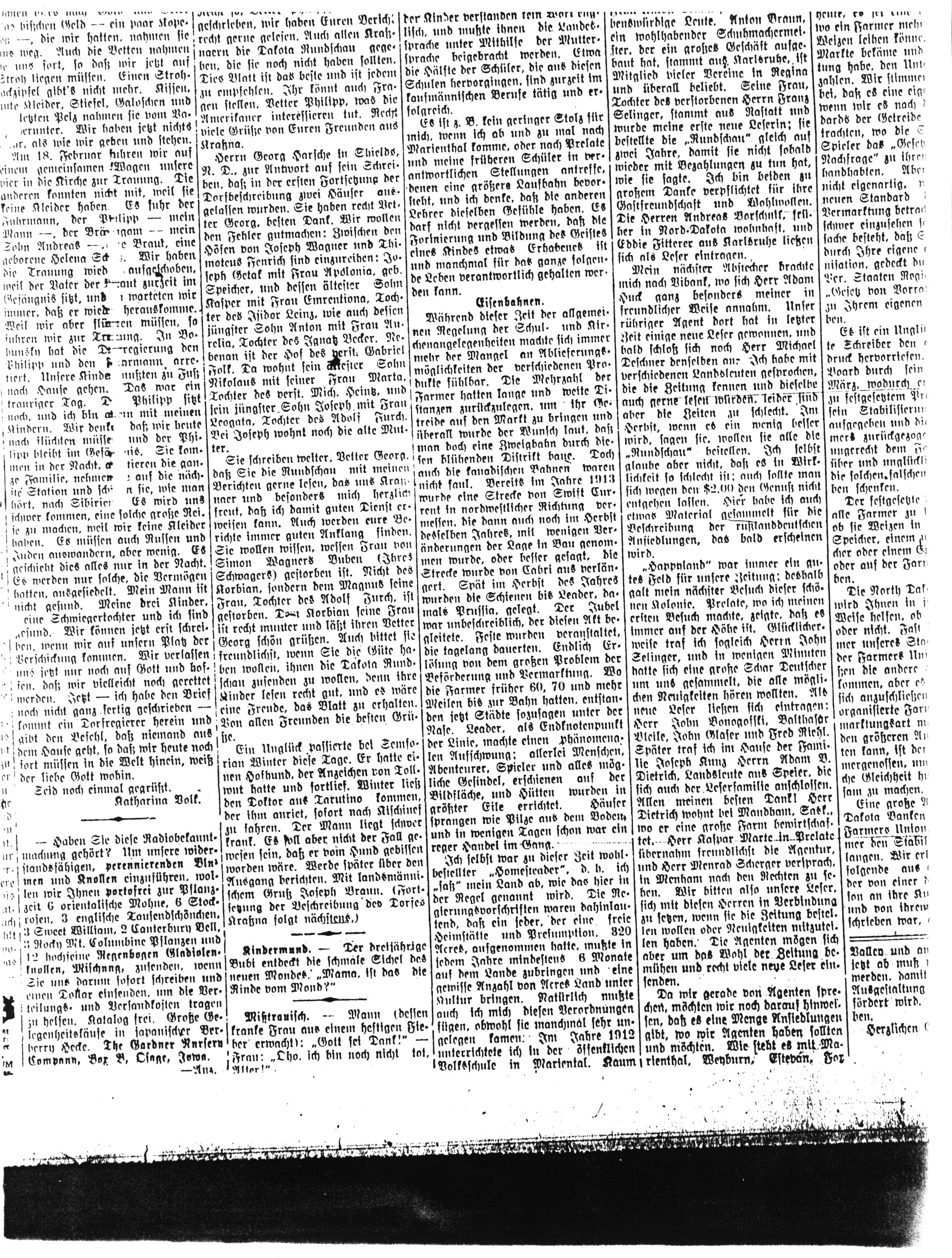
From: Krasna, Bessarabia
23 February 1930
Dear Editor Brendel:
Currently it is quite dusty. I wish it would rain or snow hard so that the earth could get a little moisture. Well, it may happen yet. God is still alive and well.
A fire broke out in the hay barn of Eduard Ruscheinsky on February 17 at 9:00 PM. It was doused quickly, however. While people were busily fighting the fire, thieves broke in at widow Luzia Gross and stole some cash as well as papers. The woman had just sold a cow. The thieves must have been after it, but the widow took the money with her when she went across the street to attend wedding celebrations. At the same time, the home of Erasmus Bunikovsky [Boniakowski] was broken into and the thieves made off with a wallet and a few small items. They vanished without a trace. Arsonists are setting fires to provide cover for thieves. It is time to do something about it.
Peter Folk, nicknamed Metheise Peter, died suddenly on February 11. He had gone to get oats for his horses when he dropped dead. He leaves behind his second wife Marianna nee Hartmann and several children. He was 66 years old.
Weddings: Widower Alex Deichert and the daughter of Heinrich Mueller [Müller], Ottilia. – Isidor Ternes, son of Martin Ternes and Luzia Furch, daughter of Valerian – Nikolaus Mueller [Müller] and Marianna Keller, daughter of Peter Keller. We wish the young couples lots of happiness.
Special thanks to Philipp Kahl from Shields, North Dakota for his report. Good work, Cousin Philipp, we enjoyed reading the article. Send the Dakota Rundschau to all the Krasna folks not getting it already. It is a great publication and should be a household item. Cousin Philipp, feel free to ask the kind of questions of interest to the Americans. We send greetings from all your friends of Krasna.
In answer to Georg Harsche in Shields, North Dakota. He asked why our first village description omitted two homesteads. He was right to point out that error and here is the correction —
Between the homesteads of Joseph Wagner and Timotheus Fenrich are the homes of: Joseph Gedak, wife Apolonia nee Speicher and their oldest son, Kasper with wife Emerentiana, daughter of Isidor Leinz and his youngest son Anton with wife Aurelia, daughter of Ignatz Becker. Next to it is the house of the late Gabriel Folk. His oldest son Nikolaus and wife Martha, daughter of the late Michael Heintz and his youngest son Joseph with wife Leogata, daughter of Adolph Furch. The old mother lives with Joseph.
You write also, Cousin Philipp, that you like the Rundschau and my reports. The Krasna folks and I are very happy to hear that. Your reports are all eagerly anticipated and appreciated.
You wanted to know which wife of Simon Wagner’s son has died. Not Korbian’s, but Magnus’, the daughter of Adolph Furch is the one who died. Korbian’s wife is well off and wants to send her regards to her nephew Georg. She asks whether it would be possible to send a subscription to the Dakota Rundschau. Her children are good kids and they too would like to read the paper. Greetings from all your friends.
There was a mishap at Semforian Winter’s place recently. He had a dog that showed signs of rabies and ran off. Winter called the doctor in Tarutino who told him of a man in Kischinev where a man was ill to the death. Apparently, the dog did not bite him. I will find out more about this and write at a later date.
Fellow countryman’s greetings. A continuation of the village description is in the works.
Joseph Braun
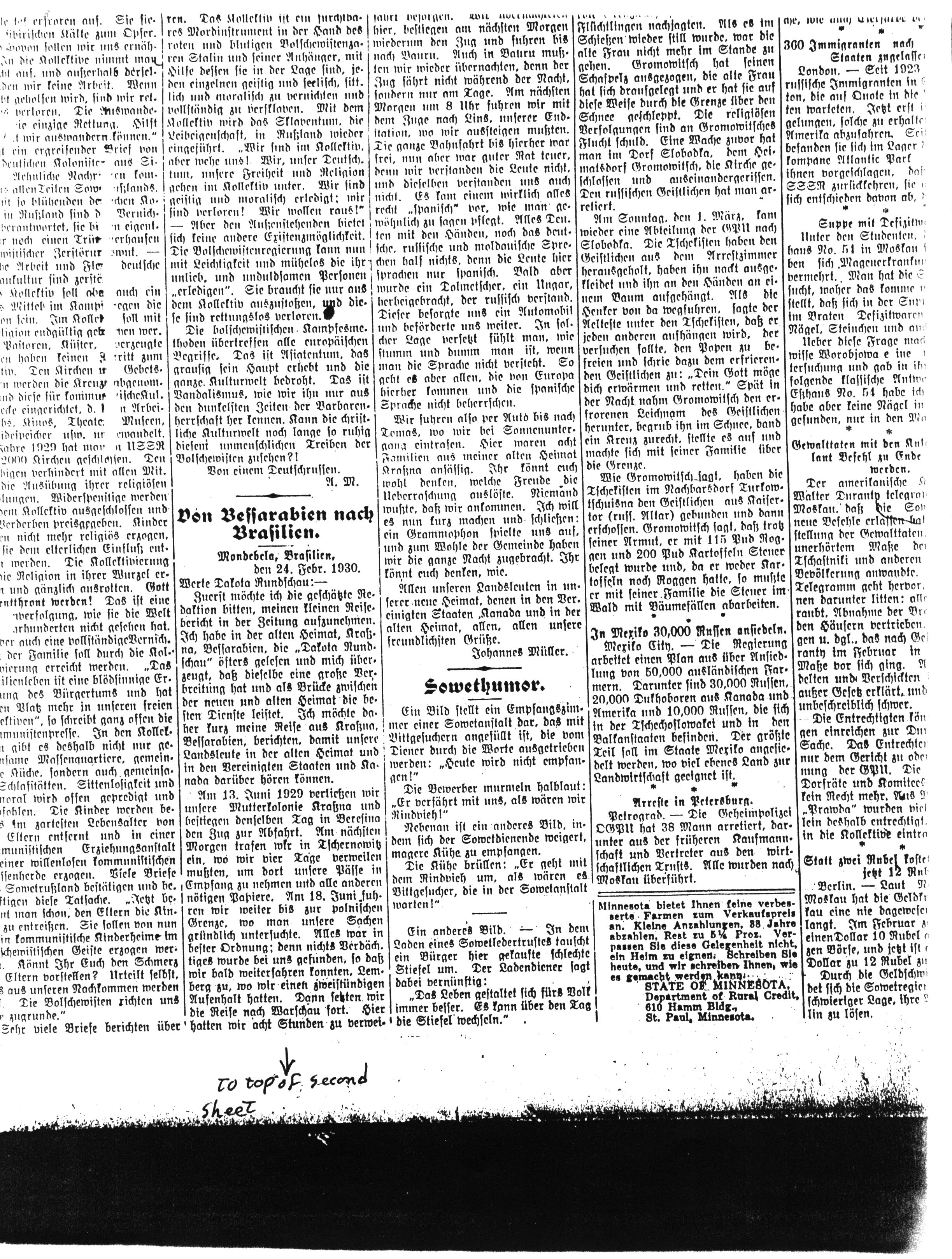
From: Bessarabia to Brazil
Montebello, Brazil
24 February 1930
Dear Dakota Rundschau:
First, I would like to ask your staff to include my little report in your newspaper. I have enjoyed reading the Dakota Rundschau in my old home in Krasna. I have found that it has a well spread out readership and serves as an excellent bridge of the gap between the old and new homelands.
Let me briefly describe our journey from Krasna, Bessarabia to illustrate the trip to our fellow countrymen in Canada, the USA and the old homeland.
We left the mother colony of Krasna on June 13, 1929 and took the train in Beresina on the same day. We arrived in Chernovitz (Tschernowitz) where we were held up for four days to get our passports and documents in order. On June 18, we continued on to the Polish border. We were thoroughly inspected, but all was in order and we could continue toward Lemberg, where we had a two-hour layover. Then we traveled on to Warsaw where we spent eight hours waiting. Our documents had to be reviewed at the consulate office. From Warsaw, we traveled to Bremen where we arrived on June 19, only to find out that our ship had left two days ago. So we waited until July 15 for the next ship. We went to Lautheim where we paid 2.1 Marks (.50 cents) a day per person for room and board. At 5:00PM on July 15, we boarded the steamer Madrid and spent five days on the ocean before arriving at a Spanish port to load and unload more passengers. The ship made several scheduled stops. Then we really went far out to sea, only water and sky as far as the eye could see. On the ninth day, we spotted the first birds and knew that landfall was imminent. We arrived in Rio de Janeiro on the tenth day and stayed in port for eight hours before continuing on to Santo, our destination by ship.
We left the ship around 4:00PM. It was a strange feeling to be on solid ground again. We obtained our free travel tickets to the interior and left for San Paulo where we arrived at 5:00PM. We obtained more travel tickets, spent the night and took another train to Bauru where we spent another night, as the train does not run at night. We continued on to Lins the following day, our final destination by train. Although the train travel was free, we had one heck of a time trying to make ourselves understood. Everyone there only spoke Spanish, and all our German, Moldavian and Russian was to no avail. Hand signals and miming worked to a degree. We did get an interpreter however, a Hungarian who spoke Russian. He helped us to obtain a car, which we could use to continue on to Tomas, where we arrived at sunset.
Being in a foreign country without the knowledge of making oneself understood is a strange feeling. One feels numb and dumb, but this happens to all Europeans who come here without the knowledge of Spanish.
In Tomas, we found eight families from Krishna already settled in. You can understand the joy and surprise we felt at this discovery. No one had any idea that we were coming. We had a wonderful time turning up the music and talking about friends and family. You may imagine how we spent the night to the benefit of our old community.
Greetings to all fellow countrymen in the USA, Canada and the old homeland.
Johannes Müller
en/dokumente/zeitungen/eureka/w-19300404-q1-paper.txt · Last modified: by Otto Riehl Publisher


